
7 Strategies to Improve Your Private Practice and Reclaim Your Time
Key Takeaways
- A chaotic diary costs more than time: no-shows and gaps directly affect revenue and patient experience
- Repetitive admin tasks do not need to be manual: automation frees your attention for clinical work
- Patient communication between appointments is one of the simplest ways to improve retention
- GDPR compliance is far easier to maintain when it is built into your daily workflow from the start
- The right private practice management software brings scheduling, billing, records, and reporting into one place
You did not spend years training to spend your days chasing invoices, managing a chaotic diary, or worrying about data compliance. Yet for many private practitioners in the UK, that is exactly where a significant portion of the working week goes.
Knowing how to improve your private practice is not about doing more. It is about removing the friction that stops you from doing what you do best. The UK private healthcare sector recorded a record 939,000 admissions in 2024, its third consecutive record year. More patients are choosing private care, and these seven strategies will help your practice meet that demand without the burnout.
The challenges of managing a private practice
Managing a private practice means running a clinical service and a small business at the same time. Most practitioners face the same pain points: appointment no-shows that disrupt clinic flow, admin that spills into evenings, invoices that take too long to chase, and compliance obligations that feel impossible to keep on top of without dedicated support.
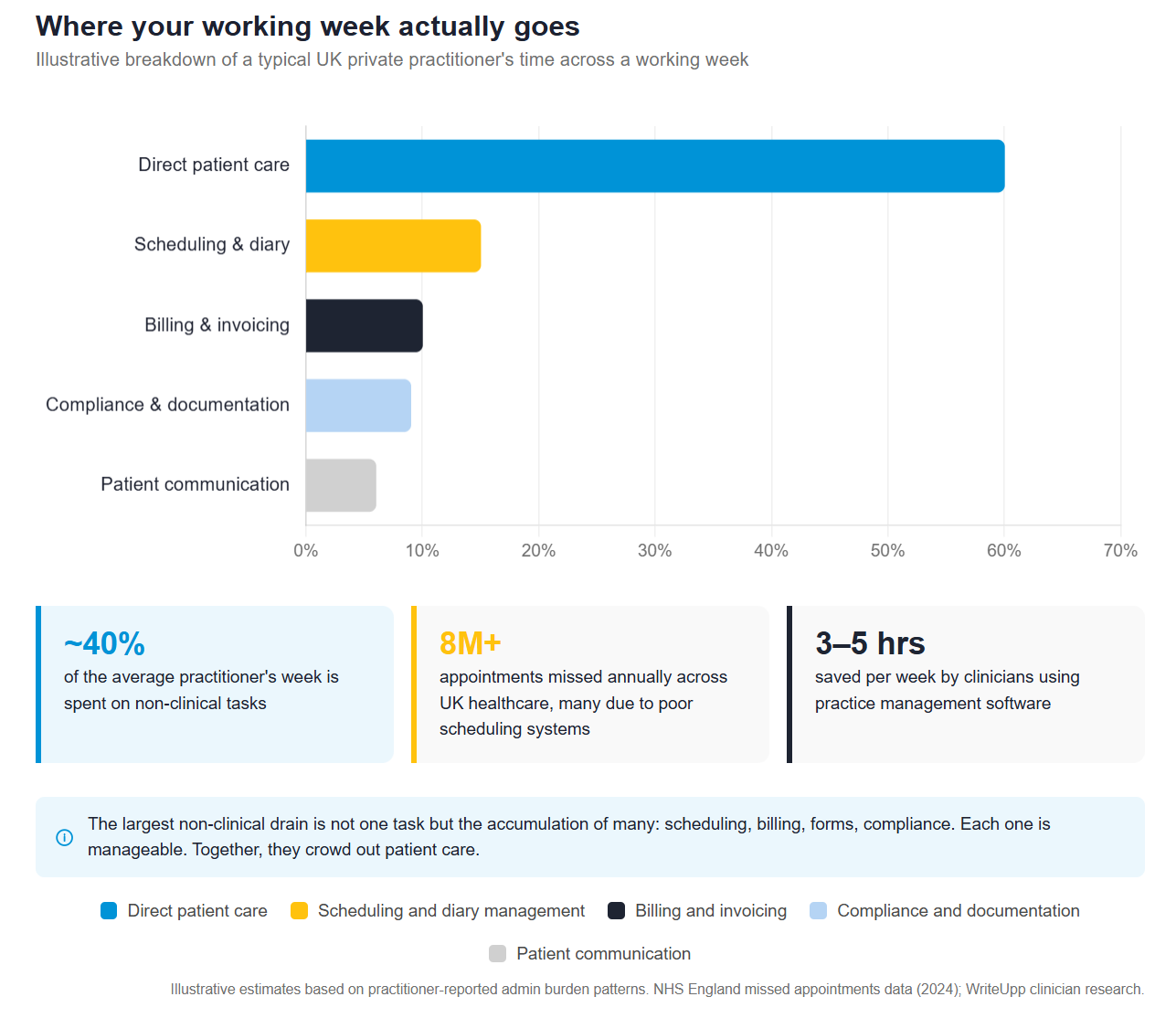
None of these challenges is unique to your practice. They are structural features of running a private clinic without the administrative infrastructure that larger organisations take for granted. Each one is solvable, and the solutions do not require a bigger team.
7 strategies to improve your private practice
1. Fix your scheduling before it fixes you
A disorganised diary costs more than time. No-shows, double bookings, and last-minute gaps create a ripple effect through your whole day, and each missed appointment is lost revenue that is rarely recovered. NHS England has highlighted that over eight million appointments are missed each year across UK healthcare settings, a problem that private practices are equally familiar with.
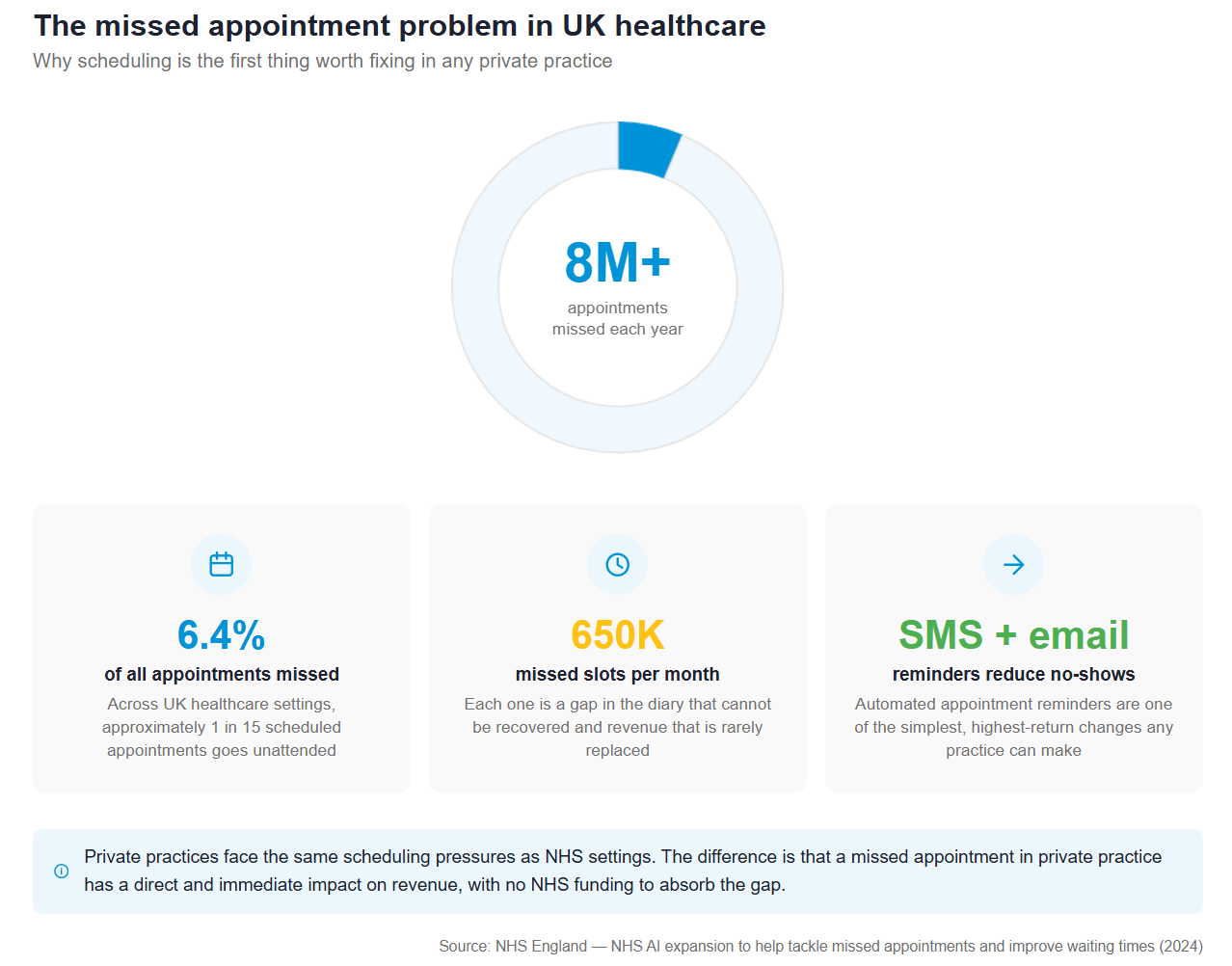
Automated appointment reminders sent by SMS or email give patients a timely nudge and significantly reduce the likelihood of a forgotten slot. When patients can also self-schedule online at any time of day, your diary fills more consistently with far less back-and-forth.
Visibility matters too. When your schedule shows conflicts at a glance, tracks appointment statuses, and updates in real time, you have control over clinic flow rather than having it control you.
Daniel Blackman, a clinical psychologist at Durham and Dales Clinical Psychology, put it simply: automated appointment reminders have resulted in a very low DNA rate across his practice.
2. Automate the admin that's eating your day
Most private practitioners underestimate how much time they lose to repetitive administrative tasks. Sending intake forms, chasing pre-appointment paperwork, confirming bookings, and following up after sessions all add up across a working week.
Digital intake forms that go out automatically before a first appointment, confirmation messages that send without anyone pressing a button, and follow-up workflows that trigger after a session are all achievable with the right setup. Automated technology handles these steps consistently in the background, so nothing slips through the cracks. When patients complete forms online before arriving, time is saved on both sides and paper handling at the front desk disappears.
Philip Newton, a physiotherapist at Newton Physiotherapy, describes the impact clearly: clinical note-taking was dramatically shortened, and the system required minimal administrative effort to keep running. That is exactly what automation should feel like.
3. Take the friction out of billing and payments
Billing is one of the most common sources of stress in private practice. Manual medical billing takes time, errors create delays, and chasing outstanding balances is an uncomfortable task that most practitioners would rather avoid. When patient billing is slow to process, cash flow suffers, and that puts pressure on the whole operation.
Automated invoicing removes the most time-consuming parts of the process. An invoice generated immediately after an appointment, sent directly to the patient or their insurer, and tracked through to payment is a far more efficient system than creating invoices manually at the end of the week.
For UK private practitioners working with both self-pay patients and private medical insurance, having a billing system that handles both clearly is not a luxury. It is a basic operational requirement.
4. Communicate better to retain more patients
Patient retention is a business metric as much as a clinical one. A patient who feels well-informed, valued, and easy to contact is far more likely to rebook, refer others, and stay with your practice long-term. Patient loyalty is built through consistent, thoughtful communication, not just good clinical outcomes. Weak communication does the opposite: patients drift away, not always because of dissatisfaction with the care, but because the experience around it felt uncertain or difficult.
Timely appointment reminders, clear confirmation messages, and a brief follow-up after a session are three of the most practical private practice tips for keeping patients engaged. A short check-in message after a first appointment, or a reminder that a follow-up session might be beneficial, shows patients that their care continues between visits.
This does not require more staff time. It requires a system that handles routine communication automatically, consistently, and in a tone that reflects your practice.
5. Add telehealth to expand without adding overhead
Video consultations have moved from a pandemic workaround to a permanent fixture in private healthcare. For many UK practitioners, they now represent a meaningful proportion of the weekly caseload. Patients who struggle to travel, those with demanding work schedules, or those who simply prefer the convenience of a remote appointment represent a portion of demand that a face-to-face-only practice cannot serve.
Adding telehealth through a platform built specifically for healthcare, rather than a generic video tool, ensures that consultations are private, GDPR-compliant, and properly documented. Integrating video directly with your clinical records and appointment system is far simpler to manage than a separate consumer tool bolted on to your workflow.
For many appointment types, particularly follow-ups, it is a better experience for the patient and a more efficient use of your time.
6. Make GDPR compliance part of your workflow, not a chore
GDPR compliance is non-negotiable for UK private practices. As a healthcare provider, you are handling special category data, and the obligations around storage, access, consent, and data subject rights apply to every patient record you hold. The Information Commissioner's Office sets out what is expected of healthcare organisations, and the standards are specific.
The practical problem is that manual data handling creates compliance risk. Paper records, shared spreadsheets, and unsecured email threads are all potential vulnerabilities, and weak cyber security practices in a healthcare setting can have serious consequences. When data is stored in a cloud-based system with encrypted records, access controls, and audit trails, compliance becomes a feature of your daily workflow rather than a quarterly anxiety.
7. Use your practice data to make better decisions
Most private practitioners are sitting on useful data they never look at. Appointment volumes by day of week, revenue by service type, cancellation rates, and patient rebooking patterns are all insights that can inform better decisions about staffing, pricing, capacity, and service mix.
Without a reporting function, these decisions get made on instinct. With one, they get made on evidence. Knowing that a particular service consistently fills fastest, or that certain slots have a higher no-show rate than others, gives you something concrete to act on.
Sally Otto, a psychotherapist in private practice, describes it well: monthly financial forecasts and reports now keep the business side of things in focus. That kind of visibility changes how you manage your clinic, not just how you report on it.
Simplify your private practice with WriteUpp
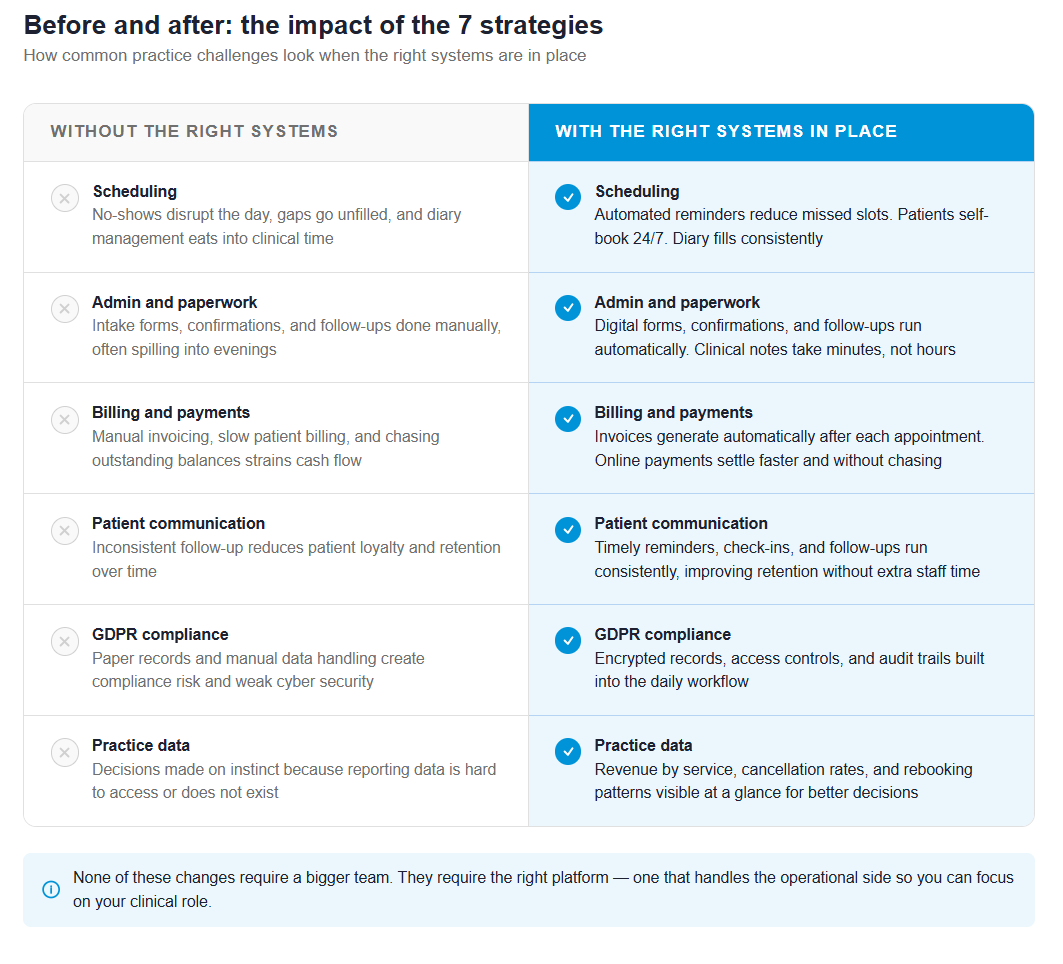
Every strategy in this post points to the same underlying need: a system that handles the operational side of your practice so you can focus on the clinical side. WriteUpp is built specifically for UK private practitioners and brings the following together in one platform:
- Online booking: let patients book, cancel, or reschedule appointments 24/7 without calling your front desk
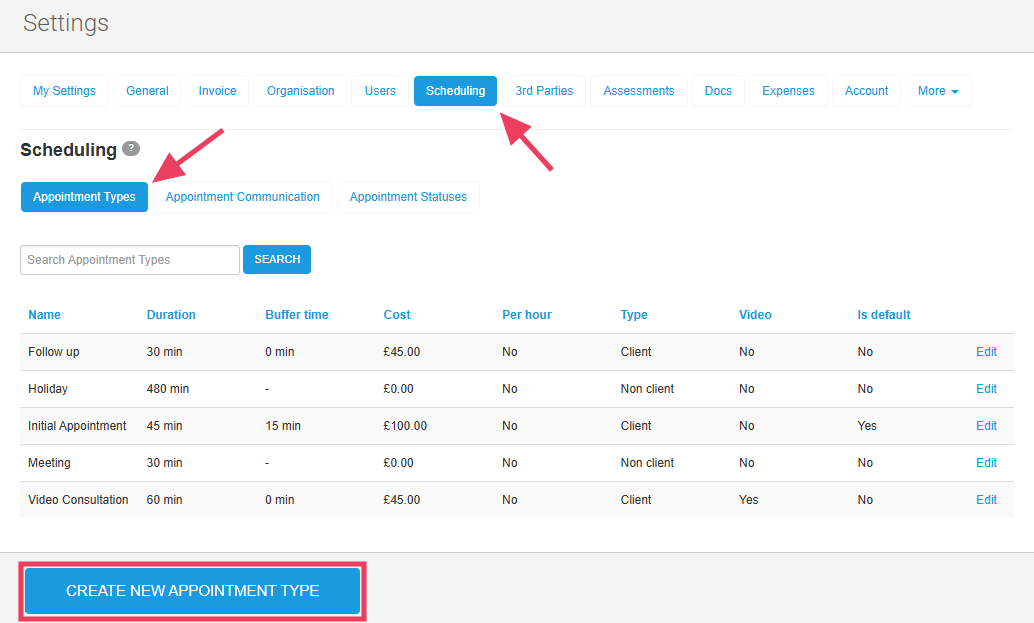
- Diary management: view and manage your full schedule in real time, with automated reminders that reduce no-shows
- Smart forms: send digital intake and assessment forms to patients before their appointment, with responses saved directly to their record
- Payment processing: generate invoices automatically, accept online payments, and track outstanding balances without chasing
- Video consultations: conduct secure, GDPR-compliant telehealth appointments directly within the platform
- Private practice software: an all-in-one system designed around how allied health professionals actually work
- Security: ISO 27001 certified and GDPR-ready, with encrypted records, access controls, and audit trails built in
Take the first step towards a better practice
Improving your private practice does not require a major overhaul. It requires fixing the right things in the right order, starting with the areas that are costing you the most time and energy each week. Whether that is scheduling, admin, billing, or compliance, the strategies in this post are practical starting points that free you to focus on your clinical role rather than the admin that surrounds it.
Start your free 30-day trial today and see how WriteUpp can help your practice run the way it should. No credit card required, no commitment, just a clearer, calmer way to work.








Join over 50,000 clinicians that we've helped using WriteUpp
Start my free trial