
Is online payment processing worth it for private practices?
Key Takeaways
- Card payments land in your account faster than bank transfers, giving your practice a clearer picture of cash flow without the waiting.
- Taking payment at booking means patients have a financial commitment, and committed patients show up.
- When a patient pays online, your invoice updates itself, no manual matching, no chasing, and no end-of-week reconciliation.
- Your patients already expect to pay by card, pay link, or mobile wallet, and a practice relying on cash or bank transfers creates unnecessary friction.
- A PCI-DSS compliant processor means raw card details never pass through your system at all, keeping patient data secure without extra burden on your team.
If you are still sending invoices and waiting for bank transfers to clear, you are not alone. A lot of private practitioners in the UK manage payments this way, and it works, up to a point. But chasing unpaid invoices, manually reconciling payments, and fielding calls from patients asking for bank details all take time. Time that could be spent on clinical work or, frankly, anything else.
Online payment processing for private practice is not a complicated overhaul. It is a practical switch that expands your online payment options and changes how quickly you get paid, how much admin your team handles, and how easy the whole process is for your patients. Here are six benefits that answer the question of whether it is worth it.
6 benefits of online payment processing for private practice
1. Get paid faster, often the next working day
Bank transfers can take two to three working days to clear, and that is assuming the patient remembers to send the payment at all. With online payment systems, funds from credit and debit card payments typically arrive in your account within one to two working days via Stripe and sometimes as quickly as the next working day, depending on your payout settings.
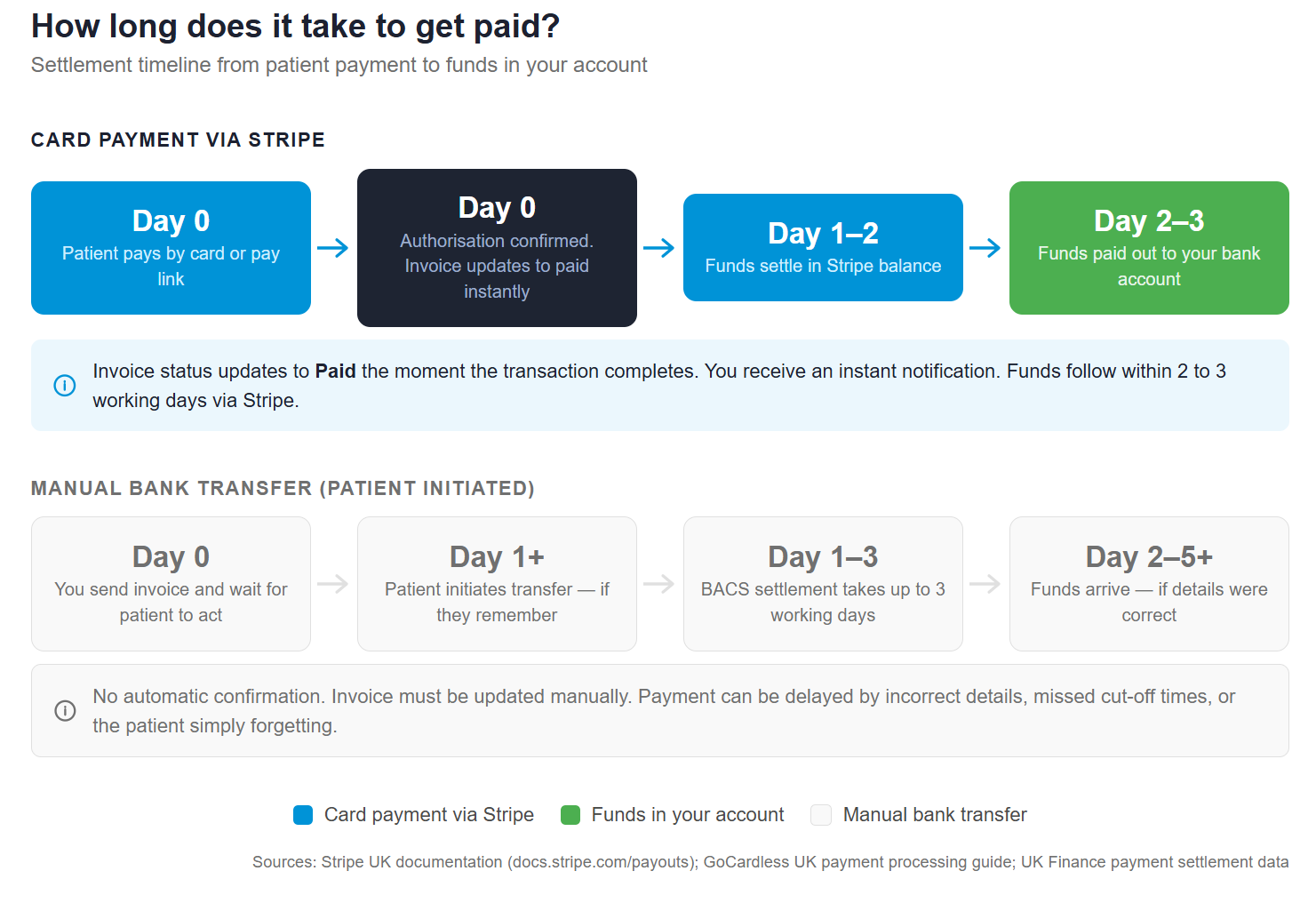
For a private practice managing cash flow month to month, that difference matters. Faster settlement means you know where you stand financially without waiting on payments that may or may not arrive when expected. It also reduces the awkward situation of chasing a patient for a payment that is technically overdue but practically just slow.
If you want to understand what happens between a patient paying and money arriving in your account, our guide to how online payment processing works covers the full process.
2. Reduce no-shows with pre-payment
A patient who has already paid for their appointment is significantly more likely to attend it. Taking payment at the point of booking is one of the most reliable ways to reduce no-shows in private practice, and it is a direct benefit of integrating online payments with your booking system.
When a patient pays before their appointment is confirmed, the financial commitment is made. That changes their relationship with the booking. Pre-payment does not eliminate cancellations, but it substantially reduces the casual kind, where a patient simply does not show up because there is nothing at stake.
This does not mean requiring full payment for every patient in every situation. For established patients with regular bookings, pay-after works fine. For new patients, high-value appointments, or anyone with a history of cancellations, requiring payment upfront gives your schedule and your revenue real protection.
3. Cut invoicing and admin time
Manual invoicing takes longer than it looks. Creating the invoice, sending it, waiting for payment, checking the bank, and updating your records. Each step is small, but they add up across a full patient list. Government research shows that UK businesses spend an average of 86 hours a year chasing late payments, time that online payments remove from your workload entirely. When a patient pays online, that entire chain collapses into one step.
With integrated online payments, the invoice in your practice management system updates from unpaid to paid the moment the transaction goes through. You receive an instant notification. There is no manual matching, no bank statement cross-referencing, and no end-of-week reconciliation exercise.
For practices handling a high volume of appointments, this is one of the most tangible day-to-day benefits of online payment processing. Your team spends less time on payment admin and more time on work that directly supports patient care. And because the record updates in real time, you always have an accurate view of which invoices are paid and which are outstanding, without running a manual check.
4. Make it easier for patients to pay
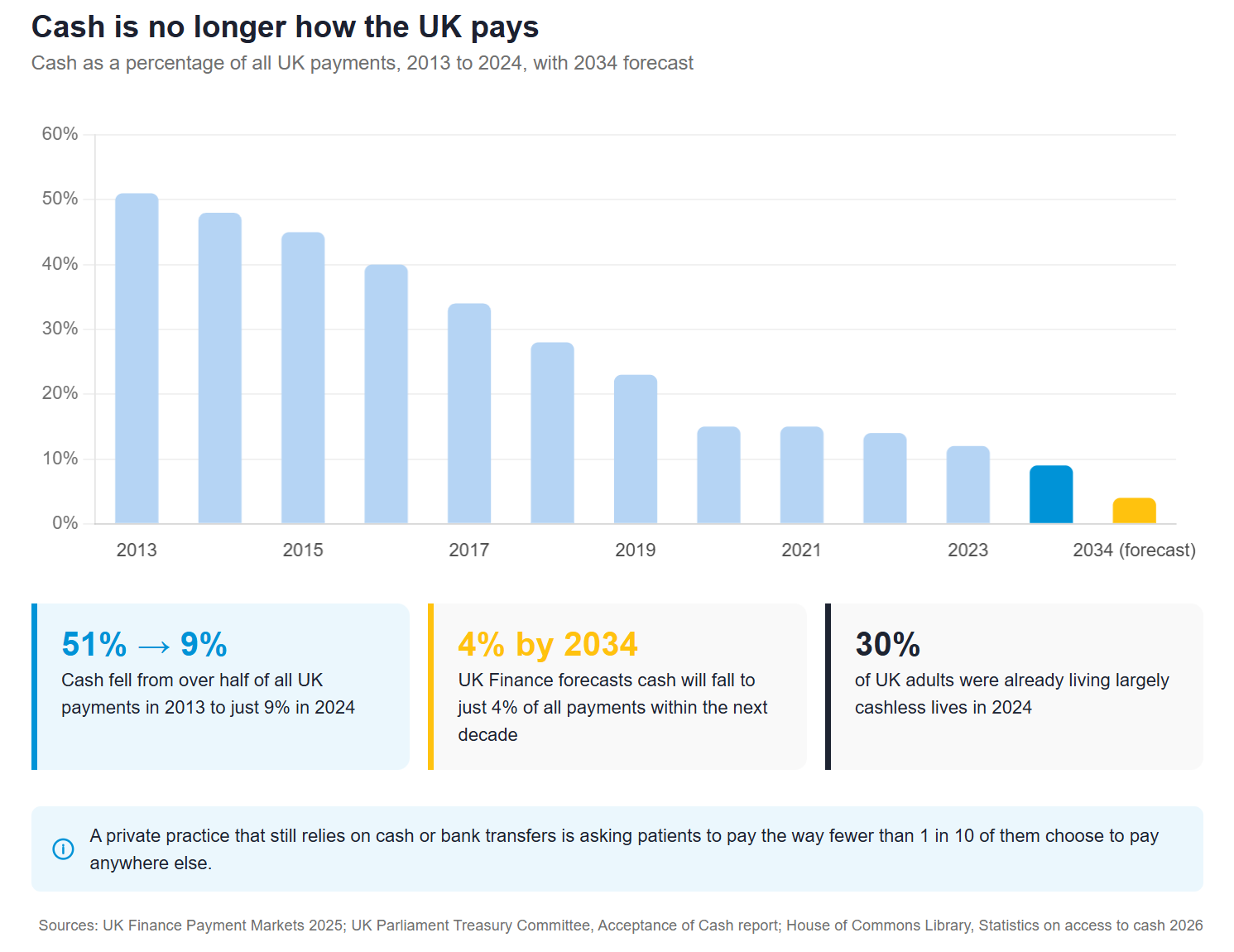
Patients expect to pay by card or phone. That is how they pay for everything else, and a healthcare practice that requires a bank transfer or cash is creating friction that patients notice. According to the UK Parliament Treasury Committee, cash fell from 51% of all UK payments in 2013 to just 12% by 2023, with the shift driven by consumers increasingly preferring card and digital payments. Your patients are already living largely cashless lives, so your payment options should reflect that.
A pay link on your invoice lets patients settle their bill with one click from their email, without calling the practice or logging into anything. In-clinic, contactless payments via Apple Pay, Google Pay, and other mobile wallets mean patients can pay and leave without delays.
Reducing friction at the payment stage is not just about convenience. It shortens the time between appointment and payment, which directly affects how quickly your invoices are settled. For a full breakdown of the payment methods worth offering, see our guide to online payment methods for private clinics.
5. Keep payments secure and compliant
Handling patient payments means handling sensitive patient data alongside financial data. The reassurance that this is being done securely matters, both for your own confidence and for the trust your patients place in your practice.
The right payment processor will meet recognised security standards and be PCI-DSS compliant. This means raw card details never pass through your practice management system at all. The payment gateway handles that data directly, so you are not storing or transmitting card information yourself. Your exposure to fraud risk is minimal, and the compliance burden sits with the processor, not with you.
For a detailed look at what PCI-DSS and GDPR compliance means for your clinic's payment processes, see our guide to compliant payment processing for healthcare practices.
6. Lower your overhead costs
Cash and manual payment handling carry hidden costs that are easy to overlook. Time spent counting cash, making bank runs, and manually reconciling payments all have a real cost, even if it does not show up as a line item. Unlike card transaction fees, which are transparent and predictable, the cost of manual processing is often invisible until you add it up. HMRC's research suggests automating invoicing can halve processing time and reduce late payments by 20%, a direct saving for any practice still relying on manual billing.
Switching to online payments removes most of that overhead. But there is another cost-saving angle that is specific to private practice: part-payments.
If a patient books a follow-up appointment during a session, taking a part-payment on the spot, a deposit toward the next appointment protects your revenue without requiring full payment upfront. It is a practical middle ground that reduces no-shows for high-value treatments while keeping the patient experience straightforward. When recorded within your practice management software, the system tracks what has been paid and what remains outstanding, so nothing gets lost between appointments.
Why private practices use WriteUpp for online payment processing
WriteUpp's payment processing brings all six of these benefits into a single system, connected directly to your appointments, patient records, and invoices.
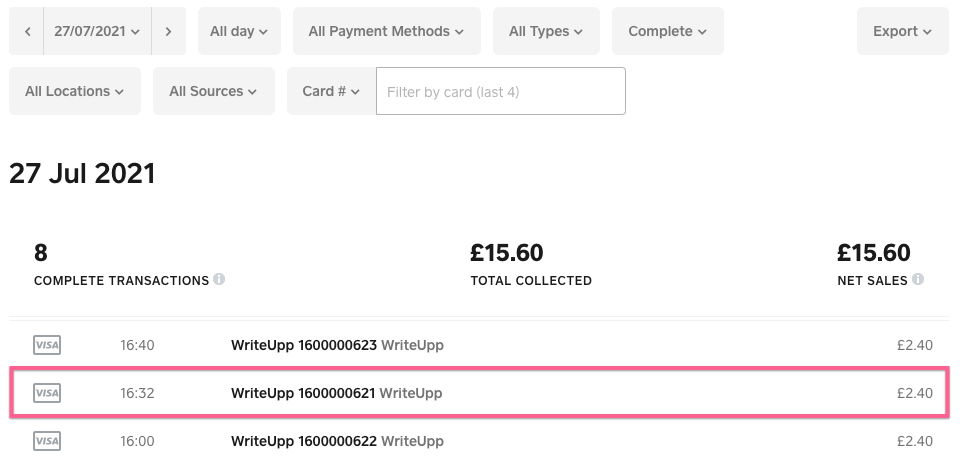
Here is what that looks like in practice:
- Pay Invoice button: Patients receive an invoice by email with a payment link. One click takes them to a Stripe-hosted payment page. The transaction completes, the invoice updates to paid, and you receive an instant notification with no manual input from your team.
- Prepayments at booking: Require payment before an appointment is confirmed through your online booking page. The appointment is added to your diary, and the invoice is created and marked as paid automatically.
- In-clinic contactless payments: WriteUpp's integration with Square supports chip-and-PIN and contactless payments via a payment terminal in the clinic, including Apple Pay and Google Pay. Transactions link directly to the correct patient record.
- Automatic reconciliation: Every payment, whether made via card, digital wallet, or invoice link, is recorded and reconciled within WriteUpp the moment it is processed.
- Part-payments: Take deposits or record split payments accurately. The system tracks what has been paid and what is still outstanding, so you always have a clear picture of where each invoice stands.
To see exactly how payments work inside WriteUpp, take a look at our complete guide to taking online payments with WriteUpp.
Start getting paid on your terms
The question at the start of this post was whether online payment processing is worth it for private practices. Based on faster settlement, fewer no-shows, less admin, easier patient payments, built-in security, and lower overhead, the answer is yes, and the switch is more straightforward than most practitioners expect.
You do not need to overhaul how you run your practice. You connect your payment processor and add a pay link to your invoices, and the benefits start from the first payment you receive.
Try WriteUpp free for 30 days and see how online payment processing works when everything is connected in one place.







Join over 50,000 clinicians that we've helped using WriteUpp
Start my free trial